BEE READY.
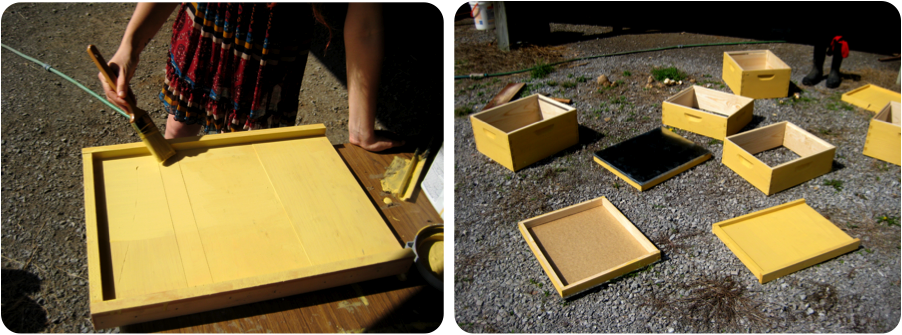
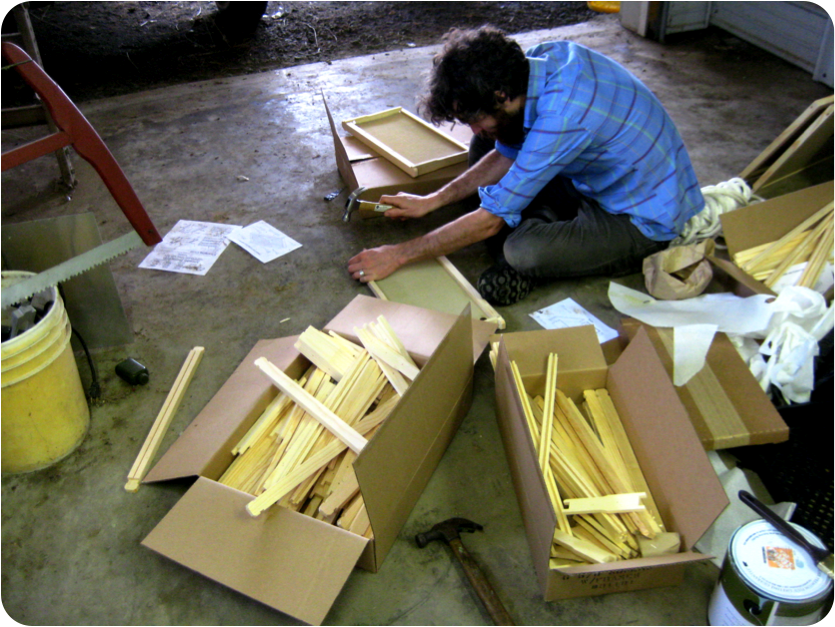
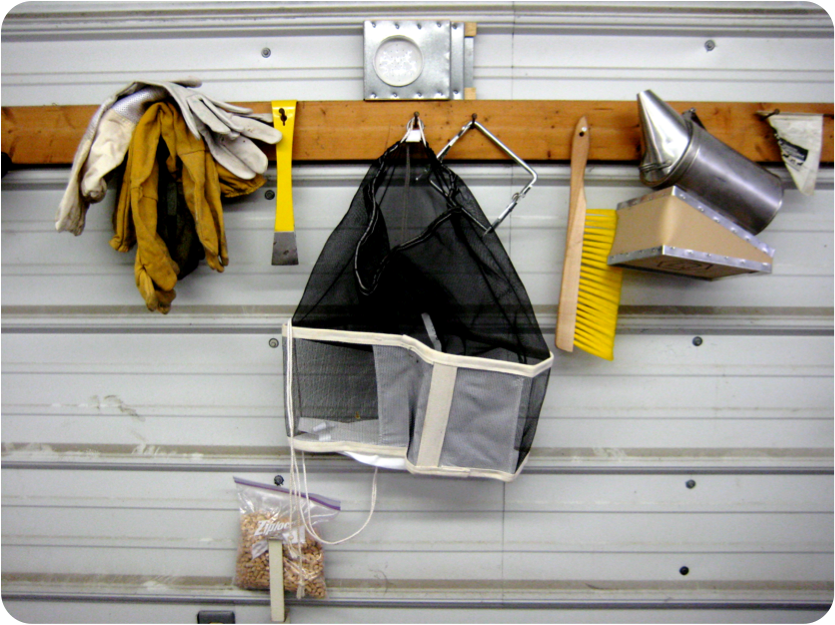
All this spring blooming and warm weather forced us to finally get the beehives completely ready for the arrival of our two little colonies! I am so anxious for them to get here! We (Jesse) finished constructing the supers and frames and then I painted all the outsides of the boxes, to weatherproof them. We ended up selecting a very light, sun-reflecting shade of yellow that is not unlike the color of honey (*thanks, Kathy, for the suggestion!*) I am rereading a lot of my bee books lately and it has me falling in love all over again, remembering this early passion of mine and why I even started farming in the first place. The beautiful relationship between the farmer and the earth, and what happens when we are good husbands to nature. We can't wait to watch these bees, to learn from them and hopefully help them along enough for us (and our shareholders!) to enjoy a bit of their sweet honey by the year's end.- Hannah.





MAKING SOIL BLOCKS.
We took full advantage of the SUMMER-like weather this week and started our first seeds! As we learned from Eric, our papa farmer, Jesse and I made our own soil mixture (soil, peat moss, compost, lime, and sand) and then used a square press to make "soil blocks." We poked the tiny seeds into these blocks and now, we wait for the magic of germination! I love this method of starting seeds, as it eliminates the need for little plastic pots and containers. Plus, the plants PREFER to grow this way. When the roots of these tiny seedlings spread throughout the soil, they will stop as soon as they hit air. But if these seeds were in a little pot, they grow out to the edges and then start circling around the edge, wrapping and wrapping, trying to find air. This is a huge waste of energy for these guys! When our soil blocks are big enough, they can simply be plopped into the ground, or even transplanted into a bigger block before they are ready for their big show. Maybe that's a lot of useless info, but to us, it really is the most incredible sight to see. And it is always fun to play around in the mud. Now let's just hope our little "greenhouse" treats them right!- Hannah.


PLOWING OUR WAY THROUGH.
Yesterday Hannah and I finished a massive project, even if it looks amusingly small. We plowed enough area for our potatoes and onions which we'll likely plant some time late next week (weather permitting). When I say we plowed, however, I don't mean that we got out the tractor, put on the plow implement and tore through the soil. Hannah and I flipped the dirt by hand, with the help of a small broad fork and shovel. I've never liked plowing, and especially using tractors - it feels too impersonal - so this has been an exciting alternative. The broad fork is a clever tool that, by slamming its five tines into the ground and leaning all of your weight on the two handles, you can loosen the soil enough to slip a shovel underneath. Once the soil was propped on the shovel, we would flip it by hand.Is this insane? Almost definitely. Will we be able to do our entire garden this way? Probably not. But will it make good potatoes and onions? Let's just say that if it doesn't, we had fun trying. It's a special part of the job, being this involved with the growing process, and we're happy to take on a little extra labor in order to know our land and vegetables are that much better. Yes, we are epically sore today, but in all the best ways. A lot of conventional farmers will get into air conditioned tractors, turn on the radio and go to work. When they're done plowing, they'll seed from the tractor, harvest from the tractor and barely get dirty. For us, what we do is not work: farming is a lifestyle for curious people, not a job. Plowing the dirt by hand is a history lesson, a biology class, a study of geology, a workout and a bad tan all wrapped up into one. We're moving and examining every inch (ok, most inches) of the dirt, pulling out bits of arrowheads and busting open geodes; unearthing ants nests and earth worms and toads––it often feels like our job is to simply remain kids and dig in the dirt. Fine by us. It was hard, it took two days, but we had a great time––your potatoes should tell you all about it.- Jesse.


